Guide
Peptides for Muscle Growth and Recovery: Hype vs. Evidence
By Alen Yaco ·
Medical disclaimer. Educational content, not medical advice. Most compounds discussed here are not approved for human use, are banned in sport, and carry real safety and legal risk. Nothing here is a recommendation to obtain, dose, or use any of them, and this guide deliberately contains no protocols. Talk to a licensed clinician, and if you compete, to your anti-doping authority.
If GLP-1 drugs are the peptides with the strongest evidence (see peptides for weight loss), the peptides marketed for muscle and recovery are close to the opposite: the louder the marketing, the thinner the human data. This guide exists because the gap between what these compounds are claimed to do and what has actually been demonstrated in humans is enormous — and because the people most targeted by the marketing, athletes, are also the ones with the most to lose.
We will take the popular compounds one at a time, separate mechanism from outcome, and be honest about where the evidence actually sits. Then we will look at the two things the marketing never mentions: anti-doping bans and an unregulated supply chain.
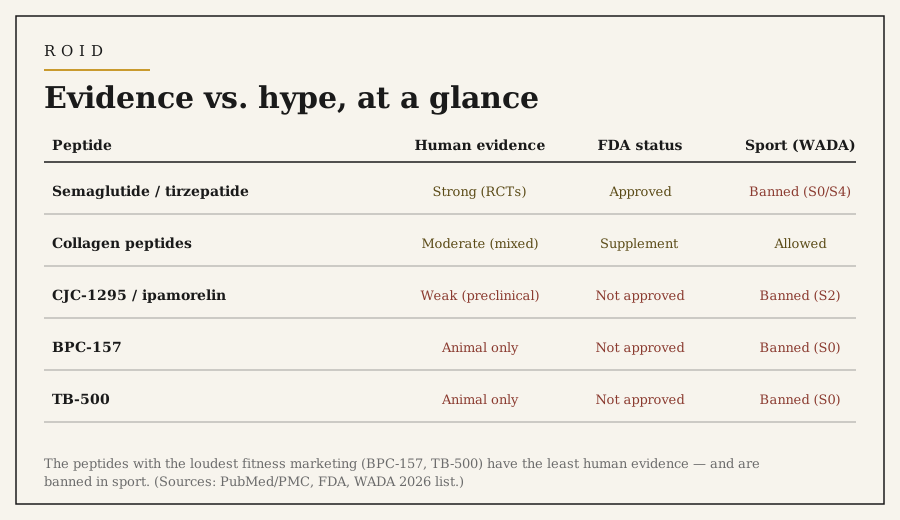
The cast: what people are actually asking about
Three names dominate the muscle-and-recovery conversation. BPC-157 and TB-500 are usually sold together as the "Wolverine stack," marketed for tendon, ligament, and soft-tissue healing. The growth-hormone secretagogues — CJC-1295, ipamorelin, and the older sermorelin — are sold for muscle gain, fat loss, recovery, and "anti-aging." Each has a plausible-sounding mechanism. None has the human evidence to match the claims.
A note on logic before we start: a mechanism is a hypothesis, not a result. "Compound X does Y in a petri dish or a rat, therefore it builds muscle in you" is exactly the inference that fails most often in medicine. Keep the evidence pyramid in mind throughout — almost everything below sits near its base.
BPC-157 and TB-500: a mountain of animal data, almost no human data
BPC-157 is a synthetic fragment based on a protein found in gastric juice. In preclinical models — overwhelmingly rats and cell cultures — it has shown genuinely interesting effects on tendon, muscle, and gut tissue healing, which is why a substantial literature and patent review exists and why it generated so much excitement. TB-500 (a synthetic version of a region of thymosin beta-4) has a similar story: promising tissue-repair and angiogenesis signals in animals.
Here is the part the marketing buries. As of 2026, BPC-157 has not been approved for human use by the FDA or any major regulator, precisely because, in the words of the peer-reviewed literature, there is an "absence of sufficient and comprehensive clinical studies confirming its health benefits in humans." There are essentially no published, well-controlled human trials demonstrating that injecting BPC-157 heals your tendon faster than rehab alone. TB-500 is in the same position — animal signals, no controlled human efficacy data, manufactured largely outside regulatory oversight.
This does not mean these compounds definitely do nothing. It means the honest status is unknown in humans, and "unknown" is being sold as "proven." That is the core problem.
The 2026 regulatory churn — read this carefully
The legal picture shifted in 2026 in a way that has been widely misreported as a green light. In February 2026, HHS signaled that roughly 14 of 19 peptides on the FDA's restricted "Category 2" compounding list would move off it, and the FDA subsequently removed BPC-157 and TB-500 from Category 2 — but did not approve them, leaving them in a regulatory gray zone. The Pharmacy Compounding Advisory Committee is scheduled to review them again on July 23–24, 2026.
The crucial point, which we make again in what are peptides: reclassification governs compounding legality only. It does not confer FDA approval, validated dosing, or proven benefit. A compound can become easier for a pharmacy to make and still have zero controlled human efficacy evidence behind it. Those are different questions, and conflating them is how hype outruns science.
Growth-hormone secretagogues: raising a hormone is not the same as an outcome
CJC-1295 (a long-acting GHRH analog) and ipamorelin (a selective GH secretagogue) are usually stacked because they hit the growth-hormone pathway from two angles, reportedly producing a several-fold increase in GH release versus either alone. Sermorelin is a shorter-acting cousin. Mechanistically, the chain is real and well understood.
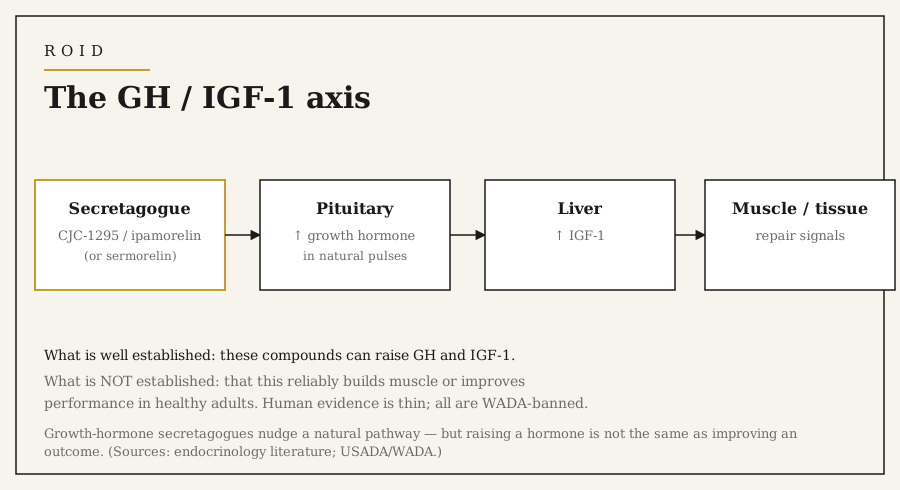
What is genuinely established is the first arrow: these compounds can raise growth hormone and, downstream, IGF-1. What is not established is the arrow that matters to a lifter: that this reliably translates into more muscle, less fat, or better performance in healthy adults. This is the same trap that sank growth hormone itself as a physique drug — GH demonstrably raises IGF-1 and increases lean body mass on the scale, much of it fluid, while controlled studies have repeatedly failed to show meaningful gains in strength or muscle quality in healthy people. Secretagogues are a softer nudge to the same axis, and they are, as multiple providers acknowledge, entirely off-label and non-FDA-approved. Sports-medicine reviews of the broader peptide boom reach the same cautious conclusion: we do not actually know much more than we used to.
The takeaway is not "these do nothing." It is that you would be paying real money and accepting real risk to manipulate a hormone, on the assumption that the manipulation produces an outcome the evidence has not confirmed.
The anti-doping problem the ads never mention
If you compete in anything drug-tested — from the Olympics to many collegiate, masters, and amateur federations — this section overrides everything else. Under the WADA 2026 Prohibited List, growth-hormone secretagogues like CJC-1295 and ipamorelin are banned (class S2), and BPC-157 and TB-500 fall under S0, non-approved substances — prohibited at all times, in or out of competition, regardless of dose or source.
Enforcement is not theoretical. USADA has explicitly warned that BPC-157 creates risk for athletes, and a Canadian athlete received a four-year ineligibility period on non-analytical evidence of BPC-157 and TB-500 use. Anti-doping runs on strict liability: if it is in your body, you are responsible, regardless of why it got there or whether it helped. For an athlete, the expected value of an unproven recovery peptide is deeply negative — you are risking your eligibility for a benefit that has not been demonstrated.
This is also where ROID's own context matters: we work with college athletics programs, and the honest message to any competing athlete is the same one anti-doping bodies give — if you are unsure, do not, and verify everything through your federation and third-party-certified products (NSF Certified for Sport, Informed-Sport).
The supply chain is the other silent risk
Even setting aside efficacy and bans, there is the vial itself. Research-use-only peptides are, by the FDA's own framing, made without FDA manufacturing oversight. Independent analyses of the gray market have found unregulated vials containing contaminants — endotoxins, mis-sequenced peptide chains, and microbial agents — alongside doses that do not match the label. You are injecting an unknown quantity of an unknown-purity substance, often sourced from an unaccountable seller. That is a meaningful infection and adverse-event risk on top of everything else.
What actually drives recovery (and builds muscle)
Step back and the irony becomes clear: the things with the strongest evidence for recovery and muscle growth are unglamorous, free, and entirely legal.
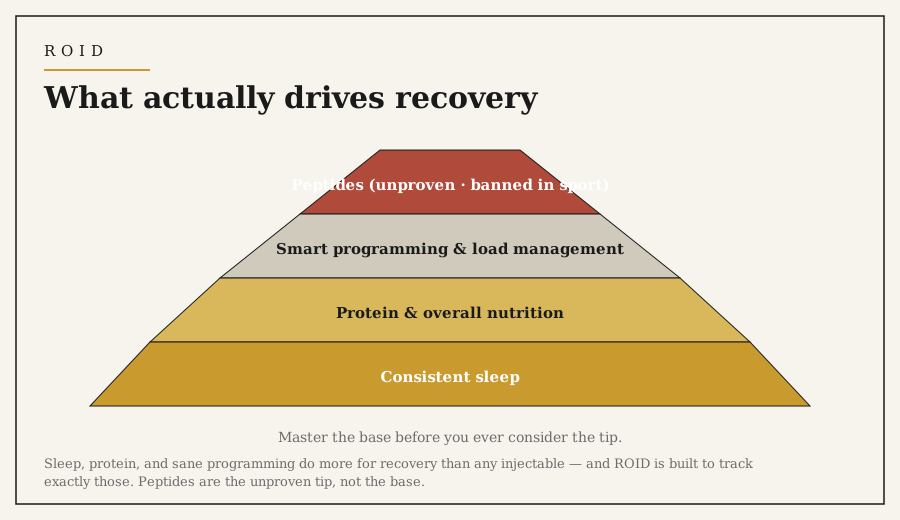
Sleep is the closest thing to a recovery "drug" that exists, with robust evidence linking it to muscle protein synthesis, hormonal balance, injury risk, and performance — and it is the one most lifters shortchange. Protein and overall nutrition are the raw materials; the resistance-training literature is unambiguous that adequate protein plus progressive overload builds muscle. Smart programming and load management — deloads, autoregulation, not running yourself into the ground — prevent the overuse injuries people then reach for BPC-157 to fix. And consistency over months is what separates people who change from people who keep restarting.
This is not a consolation prize; it is the actual answer. It is also exactly what ROID is built to support: health tracking that surfaces your sleep and recovery trends, AI-personalized training that manages load instead of grinding you down, and accountability that keeps the boring, effective basics going long enough to matter. None of it is exotic. All of it works.
The honest verdict
The muscle-and-recovery peptides are a case study in mechanism outrunning evidence. BPC-157 and TB-500 have intriguing animal data and almost no human efficacy data; the GH secretagogues reliably move a hormone without reliably moving an outcome; all of them are banned in sport, unapproved for human use, and orbited by a contaminated gray market. The 2026 reclassification made some of them easier to compound — it did not make them proven or safe. If you take one message from this guide, make it the distinction between legal to make and shown to work. They are not the same, and your tendons, your eligibility, and your wallet all depend on keeping them apart.
For the parts of recovery that are actually proven, start with the free AI fitness app, build the habit with workout accountability, and read the companion guides on weight-loss peptides and what peptides are.
Sources
- BPC-157 multifunctionality — literature and patent review (PMC)
- BPC-157 as a cytoprotectant; lack of human approval (PMC)
- FDA: July 23–24, 2026 Pharmacy Compounding Advisory Committee meeting
- What the BPC-157 / TB-500 503A review means (Lengea Law)
- USADA: BPC-157 creates risk for athletes
- WADA Prohibited List (USADA)
- CJC-1295 + ipamorelin: benefits, safety, off-label status (Innerbody)
- The boom of peptides in sports medicine (AOSSM)
Frequently asked questions
Do BPC-157 and TB-500 actually work for healing?
In animals, they show real tissue-repair effects, which is why they are studied. In humans, there are essentially no well-controlled clinical trials proving they heal injuries faster than rehab alone — the honest status is 'unknown in humans.' As of 2026 neither is FDA-approved; both were removed from the FDA's Category 2 compounding list but not approved, and they remain banned in sport.
Are CJC-1295 and ipamorelin good for building muscle?
They reliably raise growth hormone and IGF-1, but raising a hormone is not the same as building muscle. Controlled human evidence that GH secretagogues meaningfully increase strength or quality muscle in healthy adults is weak — mirroring growth hormone itself, which raises IGF-1 without proven strength gains in healthy people. They are non-FDA-approved and used entirely off-label.
Are recovery peptides banned for athletes?
Yes. Under the WADA 2026 Prohibited List, BPC-157 and TB-500 fall under S0 (non-approved substances, banned at all times) and GH secretagogues like CJC-1295/ipamorelin under S2. Anti-doping uses strict liability, and athletes have received four-year bans on non-analytical evidence alone. If you compete in a tested sport, the risk vastly outweighs any unproven benefit.
Did the 2026 FDA changes make BPC-157 legal and safe?
No. In 2026 the FDA removed BPC-157 and TB-500 from its restricted Category 2 compounding list, with a further advisory-committee review set for July 2026. That affects compounding legality only — it does not grant FDA approval, standardized dosing, or proven benefit, and it does not change their banned status in sport. 'Legal to compound' and 'shown to work and safe' are different things.
What actually helps recovery and muscle growth without peptides?
The best-evidenced levers are unglamorous and free: consistent sleep, adequate protein with overall good nutrition, progressive resistance training with sensible load management, and consistency over months. These outperform any injectable peptide on the strength of the evidence — and tracking sleep, nutrition, and training is exactly what ROID is built to do.