Guide
What Are Peptides? A Complete, Evidence-Based Guide
By Alen Yaco ·
Medical disclaimer. Educational content, not medical advice. Some peptides discussed here are FDA-approved prescription drugs, some are over-the-counter supplements, and some are not approved for human use at all. Treat those categories as completely different things, and consult a licensed clinician before using anything in the prescription or research categories.
"Peptide" is the wellness word of 2026 — and one of the most abused. It is stamped on $79 face serums and $1,300-a-month weight-loss prescriptions, on collagen powders and on vials sold "for research only." The result is a single word doing the work of a dozen very different products with wildly different evidence. Headlines call it a gold rush for a reason.
This guide is the map. We will define what a peptide actually is, sort the category into the four buckets that matter, look honestly at the evidence for the consumer favorites (especially collagen), and lay out the 2026 regulatory landscape that has confused even pharmacists. By the end you should be able to read any peptide claim and place it correctly — which is the single most useful skill in this entire space.
What a peptide actually is
A peptide is a short chain of amino acids — typically 2 to 50 — linked by chemical bonds called peptide bonds. That is the whole definition, per the NIH genetics glossary and biochemistry references like StatPearls. Amino acids are the same building blocks your body uses to make everything from muscle to enzymes; string a few together and you have a peptide.
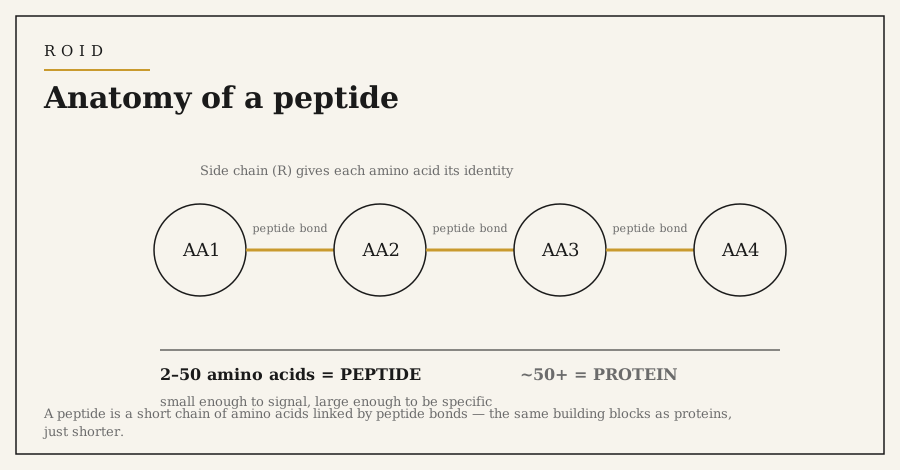
The reason peptides are biologically interesting is the sweet spot they occupy: small enough to be made synthetically and to act as precise signals, but large enough to carry specific instructions. Your body already runs on them — insulin, oxytocin, and the GLP-1 we discuss in the weight-loss guide are all peptides. A peptide is not an exotic foreign substance by nature; it is a category your physiology depends on.
Peptides vs. proteins: the only difference that matters
People often ask how a peptide differs from a protein. The honest answer is that the line is mostly about length. Proteins are long chains of amino acids (often hundreds, folded into complex 3D shapes); peptides are short chains. The rough convention is that 50-ish amino acids marks the boundary, but it is a convention, not a law of nature.
This length difference has a practical consequence that explains a lot about the market. Short peptides are easier to synthesize and, in some cases, to formulate — but most are also fragile in the gut, which is why so many therapeutic peptides have to be injected rather than swallowed. When you see a peptide sold as an oral supplement, that fragility is exactly why you should ask whether enough of it survives digestion to do anything. (Collagen is a partial exception, and we will get to why.)
The four worlds of peptides
The biggest mistake in this entire topic is treating "peptides" as one thing. They are at least four very different things, with four very different evidence bases and legal statuses.
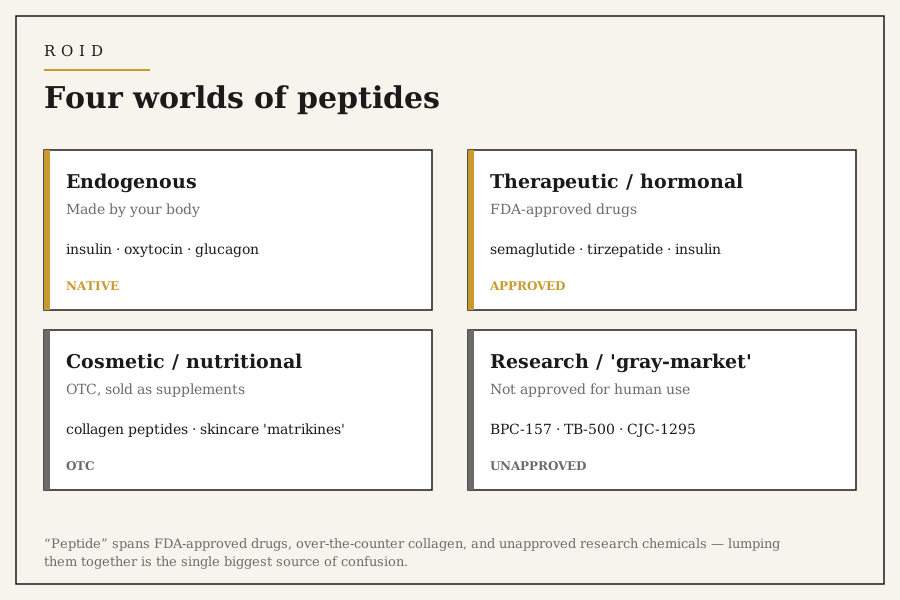
1. Endogenous peptides are the ones your body makes — insulin, glucagon, oxytocin, and hundreds more. These are not products; they are physiology, and they are the proof of concept that peptides can be powerful signals.
2. Therapeutic / hormonal peptides are FDA-approved drugs that mimic or replace those signals. Injectable insulin saved diabetes care a century ago; the GLP-1 class (semaglutide, tirzepatide) is rewriting obesity medicine now. These have the strongest evidence in the entire category because they went through full clinical trials.
3. Cosmetic and nutritional peptides are sold over the counter — collagen powders, and the "matrikine" peptides in skincare. These are regulated as supplements or cosmetics, not drugs, which means the bar for marketing claims is much lower than the bar for proof.
4. Research / "gray-market" peptides are the BPC-157s, TB-500s, and GH secretagogues covered in the muscle and recovery guide. These are not approved for human use, are sold with "research-use-only" labeling, and have human evidence ranging from thin to nonexistent.
Almost every confused argument about peptides comes from someone borrowing the credibility of bucket 2 (real drugs) to sell bucket 4 (research chemicals). Keep the buckets separate and most of the confusion evaporates.
Do collagen peptides actually work?
Collagen peptides deserve their own section because they are the peptide most people have actually tried, and the evidence is more nuanced than either the marketing ("miracle") or the cynics ("useless") suggest.
For skin, the evidence is genuinely reasonable. Multiple randomized, double-blind, placebo-controlled trials have found that oral low-molecular-weight collagen peptides can improve skin elasticity, hydration, and dermal density and reduce wrinkle severity over about 4 to 12 weeks. The proposed mechanism is that collagen-derived peptides survive digestion well enough to reach the bloodstream and act as signaling fragments that nudge skin fibroblasts to make more collagen and hyaluronic acid. The effect sizes are modest and the supplement industry funds a lot of the research, so calibrate expectations — but "modest, real benefit for skin" is a defensible reading of the data.
For joints, the picture is more mixed. Some trials report reduced activity-related joint pain and better function, and there is emerging data in knee osteoarthritis, but other studies show effects no better than placebo. The honest summary: possibly helpful for some people's joint comfort, far from guaranteed.
The reason collagen is worth highlighting is the contrast it draws. It is a peptide with real (if modest) human RCT evidence, sold legally and cheaply, with a low risk profile. That is the opposite of the injectable research peptides — and it is a useful benchmark for what "decent evidence" actually looks like in this space.
How peptides are taken — and why that matters
Route of administration is an underrated tell. Because most peptides are digested like food, the genuinely potent ones — insulin, GLP-1 drugs, the research peptides — are typically injected. That is a meaningful commitment and, for the unapproved compounds, a meaningful risk (sterility, dosing, contamination). Oral and topical peptides exist (collagen orally, "matrikines" in creams), but for those the real question is always bioavailability: does enough reach the target tissue to matter? For skincare peptides specifically, penetrating the skin barrier in an active form is a genuine hurdle that formulation can only partly solve. When evaluating any peptide product, "how is it delivered, and is that route plausible for an effect?" is one of the fastest filters you have.
The 2026 regulatory landscape (the part that confuses everyone)
2026 was a watershed year for peptide regulation in the US, and the coverage has been muddled. Here is the clean version.
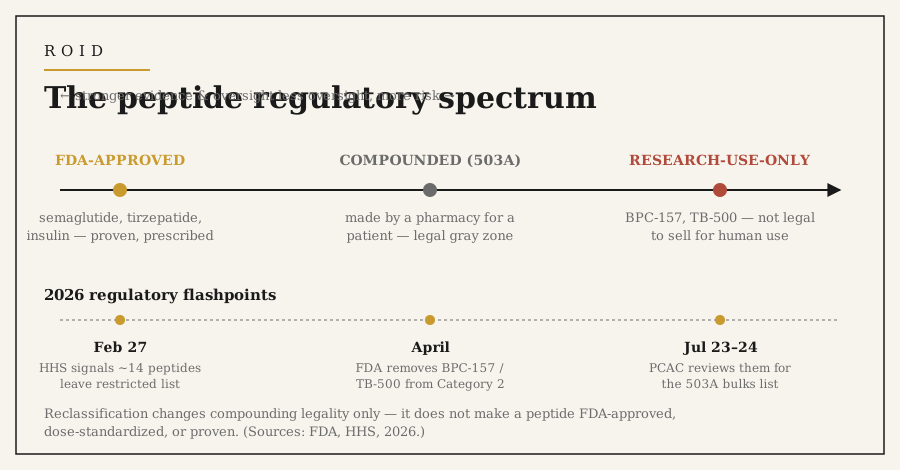
There are three tiers. FDA-approved peptides (the GLP-1 drugs, insulin) have passed full clinical review. Compounded peptides are made by licensed pharmacies under a framework called 503A — legal in specific circumstances, but not FDA-approved products. Research-use-only peptides are not legal to sell for human consumption at all.
The 2026 news concerned the middle tier. In February 2026, HHS signaled that roughly 14 of 19 peptides on the FDA's restricted "Category 2" list would move off it, and the FDA subsequently removed compounds including BPC-157 and TB-500 from Category 2 — without approving them. A further Pharmacy Compounding Advisory Committee review is set for July 23–24, 2026. Industry trackers now follow dozens of compounds and their shifting status.
The one sentence to remember: reclassification changes what a pharmacy may compound; it does not make a peptide FDA-approved, dose-standardized, or proven to work. A great deal of 2026 marketing has implied otherwise. It is wrong.
How to evaluate any peptide claim
Because the marketing is so far ahead of the science, the most valuable skill is a filter you can apply to any claim. Use the evidence pyramid.
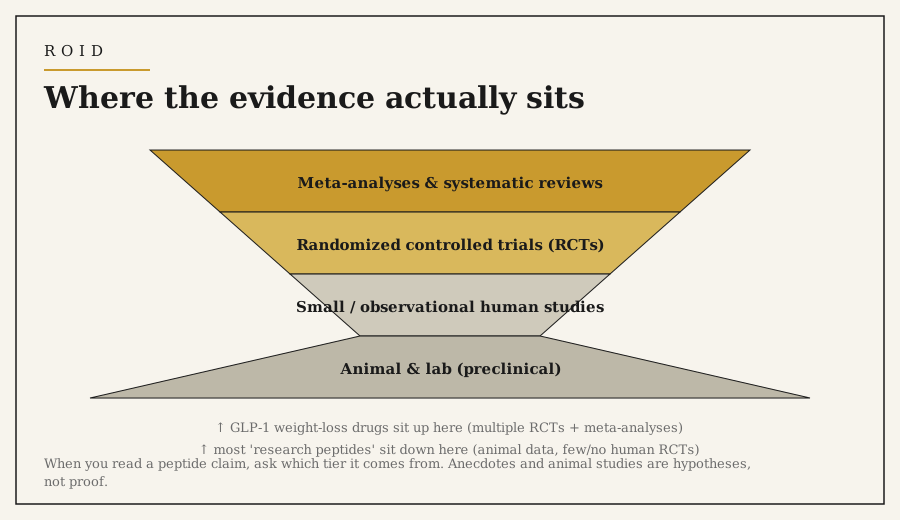
Five questions get you most of the way:
- Which bucket is it? Approved drug, OTC supplement, or research chemical? This alone tells you the regulatory and evidence baseline.
- Where does the evidence sit on the pyramid? Anecdotes and animal studies are hypotheses. Randomized controlled trials and meta-analyses are evidence. Most research-peptide claims live at the bottom.
- Is there human data specifically? "It works in rats" is the most common sleight of hand in the entire field.
- Who is selling it, and what is their incentive? A clinic or shop that profits from the injection is not a neutral source.
- What is the route, and is it plausible? An oral or topical claim has to clear the bioavailability bar.
If a product cannot survive those five questions, the absence of evidence is the finding — not a detail to be filled in later.
Safety and the gray market
For approved and OTC peptides used as directed, the safety picture is generally well characterized. The risk concentrates in the research/gray-market tier, where there is no FDA oversight of manufacturing, and independent testing has turned up contaminants and off-label dosing in unregulated vials. Add self-injection of an unknown-purity substance and you have a genuine infection and adverse-event risk on top of the unknown efficacy. "Research-use-only" is not a quality tier; it is a legal disclaimer that the product was never meant to go into a human.
The bottom line
Peptides are not a fad and they are not a scam — they are a real and important class of molecules that happens to be in the middle of a marketing bubble. The category contains some of the best-evidenced drugs of the decade (GLP-1s), a legitimately useful supplement (collagen, with modest effects), and a long tail of unproven, unapproved research chemicals wearing the same name. The 2026 regulatory churn changed compounding rules, not the underlying science. Learn the four buckets and the five questions, and you will navigate this space better than most of the people selling into it.
From here, go deeper on the two highest-interest cases: peptides for weight loss (the strong-evidence end) and peptides for muscle growth and recovery (the weak-evidence, high-marketing end). And for the parts of health that are genuinely in your control, the free AI fitness app and free calorie tracker are a better first investment than any vial.
Sources
- Peptide — NIH/NHGRI genetics glossary
- Biochemistry, Peptide — StatPearls / NIH Bookshelf
- Low-molecular-weight collagen peptides and skin (RCT, PMC)
- Sustained effects of collagen peptides on skin (RCT, PMC)
- Collagen peptides and knee joint discomfort (RCT, PMC)
- Collagen peptides in knee osteoarthritis (RCT, PMC)
- The peptide reclassification explained — Pharmacy Times
- State of peptides and GLP-1 regulation 2026 — FormBlends
- FDA: July 23–24, 2026 Pharmacy Compounding Advisory Committee meeting
Frequently asked questions
What are peptides in simple terms?
A peptide is a short chain of amino acids (usually 2–50) linked by peptide bonds — the same building blocks as protein, just shorter. Your body makes many of its own (insulin, GLP-1, oxytocin). The word also covers FDA-approved drugs, over-the-counter collagen, and unapproved research chemicals, which is why it causes so much confusion.
What is the difference between a peptide and a protein?
Mostly length. Peptides are short chains of amino acids (roughly up to 50); proteins are long chains (often hundreds) folded into complex shapes. The ~50-amino-acid boundary is a convention, not a hard rule. A practical consequence is that many peptides are fragile in the gut and must be injected rather than swallowed.
Do collagen peptides really work?
For skin, the evidence is reasonably good: multiple placebo-controlled trials show modest improvements in skin elasticity, hydration, and wrinkles over 4–12 weeks. For joints, results are mixed — some trials show reduced pain, others no better than placebo. Effects are modest and much of the research is industry-funded, so keep expectations measured. It is, however, legal, cheap, and low-risk.
Are peptides safe and legal?
It depends entirely on which kind. FDA-approved peptide drugs (insulin, GLP-1s) are safe and legal with a prescription; OTC collagen is low-risk. 'Research-use-only' peptides are not legal to sell for human consumption, have no manufacturing oversight, and have turned up with contaminants and inaccurate doses in independent testing. The category name is shared; the safety and legality are not.
Did the 2026 FDA/RFK changes make research peptides approved?
No. In 2026 the FDA moved several peptides (including BPC-157 and TB-500) off its restricted Category 2 compounding list, with another advisory-committee review scheduled for July 2026. That changes what pharmacies may compound — it does not grant FDA approval, standardized dosing, or proof of benefit. 'Easier to compound' is not the same as 'approved, safe, and effective.'